
Why a Quote Change After CAD Review Happens
Published 2026-09-17 · Machining Guides

A quote change after CAD review almost always comes down to one thing: the instant number priced your geometry, and the review step priced everything geometry alone can't show. You upload a STEP file, get a price in seconds, and a day later the confirmed number sits a few percent — sometimes more — away from it. That's not a bait-and-switch. It's a two-stage pricing model doing exactly what it's built to do.
This is not a general guide to reading a CNC quote — we cover cost breakdowns elsewhere. This piece is about the second stage specifically: what our engineering pass checks after your instant number, why it moves the price, and how to keep the gap small. Written by Ashkan, CNC engineer here at CNC Instant Quote.
Why Does an Instant Quote Change After CAD Review?
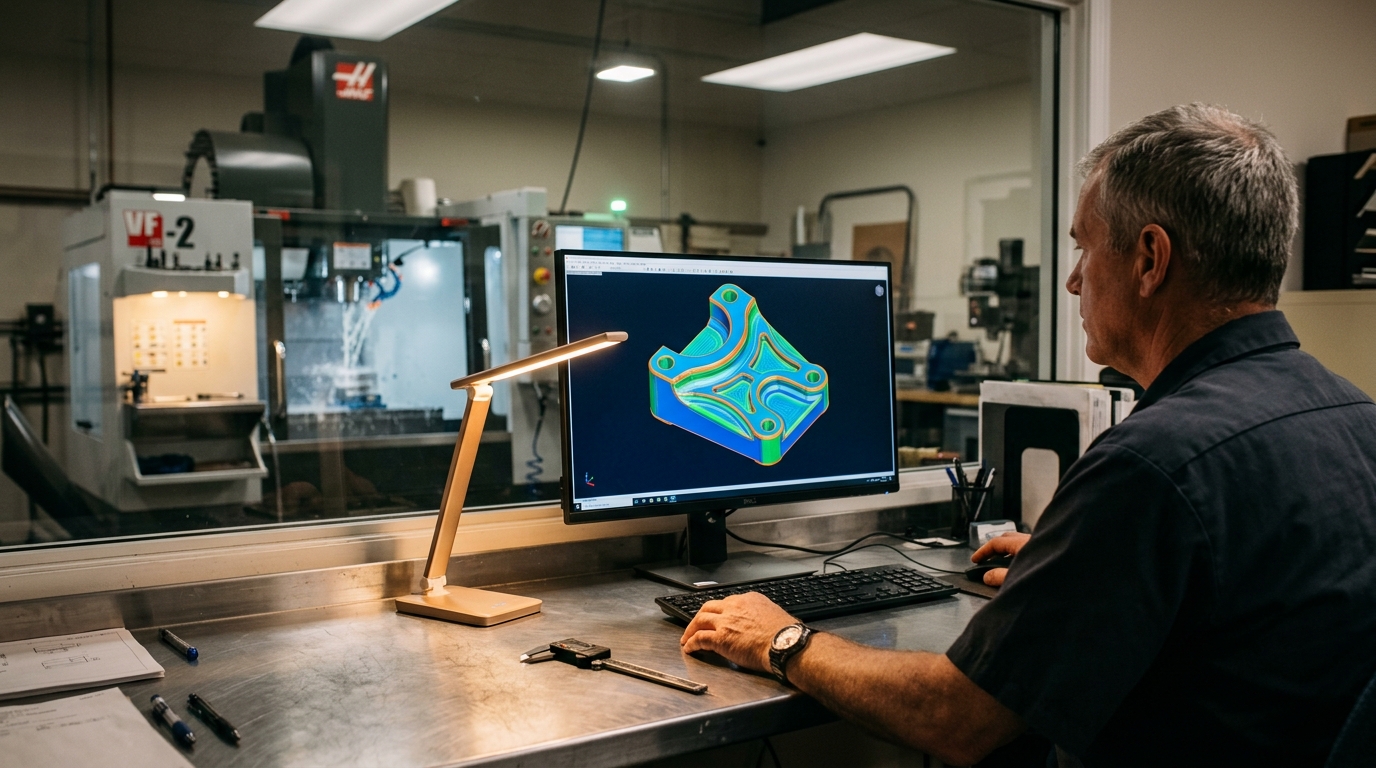
The instant engine reads your CAD geometry — part volume, hole and pocket count, wall thickness, your selected material, and a default tolerance band (ISO 2768-m equivalent) if your file doesn't call one out. That's enough to price the part in seconds because it's all sitting inside the STEP file. It's also all the engine can see.
What it can't see: whether the exact billet size for your part is on the shelf this week, whether a 0.8 mm wall in a deep pocket needs a slower feed and a smaller tool, or whether a note buried in an attached PDF calls out 32 µm Ra on a mating face. That's the job of the review step — a human plus software pass that runs after upload, before your final price locks. Geometry sets the starting number. Review confirms or corrects it.
Instant Quote vs Final CNC Quote: What Actually Changes
The gap between instant quote vs final CNC quote almost always traces to three categories, and none of them are visible from geometry alone.
- Stock availability — a 3-inch round bar in 7075-T6 may be a mill-order item this week, not shelf stock, which shifts lead time and material cost.
- Feature manufacturability — a pocket deeper than four times the tool diameter, or a wall under 1 mm on aluminum, needs a slower pass than the default assumption used.
- Missing spec — material grade and temper, surface finish, GD&T callouts, thread class, or heat treatment left off the file or the order notes.
Makerverse's 2026 buyer's guide makes the same point from the cost-formula side: when material grade, quantity, tolerances, threads, finish, or heat treatment aren't specified on a quote request, the supplier has to assume — and unclear assumptions are one of the most common reasons two quotes for the same part drift apart. Our review step exists to replace those assumptions with what your part actually needs before you commit to the number.
What Triggers a CNC Quote Adjusted After DFM Check
CloudNC's Quote Agent, built inside its own production machine shop, takes the same approach on the shop-floor side of quoting: surface DFM risk flags — a sharp internal corner, an under-spec wall, a feature that needs a second setup — before the price is finalized, so the estimator and the buyer can both see what changed and why. That's the standard we hold our own review to. A CNC quote adjusted after DFM check should always come with a reason, not just a new number.
Features that most often trigger an adjustment on our review:
- Wall thickness under about 1 mm in aluminum, or 1.5 mm in steel, which needs a slower feed to avoid chatter.
- Pockets deeper than four times the cutting tool diameter, requiring a smaller tool and more passes.
- Threads smaller than M3 or #4-40, which need a dedicated tap cycle instead of the default thread-mill assumption.
- A tolerance tighter than ±0.05 mm on a feature the STEP file didn't flag as critical.
- Sharp internal corners on a functional face that need refilleting in CAD or a secondary EDM pass.
What Our Review Step Actually Checks
After you upload a STEP file, our review confirms three things against the instant engine's assumptions: real stock on hand for the exact alloy and dimension you specified, re-timed cycle estimates for any feature that crossed the confidence threshold above, and a read of any attached drawing or note for grade, finish, and GD&T that the geometry alone doesn't carry.
In practice, most confirmed quotes hold within about 10% of the instant number. When a quote moves further than that, it's almost always one missing spec doing the work — most often the temper wasn't stated (6061 vs. 6061-T6 cut very differently), or a finish call-out showed up in the drawing but not in the order form. We confirm same-day for straightforward parts, and within one business day for anything with multiple flagged features.
How to Keep Your Number Stable
You can't eliminate the review step — and you shouldn't want to, since it's what catches a wall that won't hold up under load before you're mid-run. But you can shrink the gap between instant and final to close to zero by giving the engine what it needs up front.
- State full material spec and temper, not just the alloy family — '6061-T6' instead of '6061'.
- Note your tolerance intent even when standard: 'ISO 2768-m is fine' tells us nothing needs a second look.
- Call out thread class and finish (Ra in µm, anodizing type) if either matters to fit or function.
- Flag heat treatment and any GD&T requirement in the order notes, not just buried in a PDF layer.
- List your target quantity — batch size changes which setups make sense and can move price either direction.
FAQ: Instant Quote vs Final CNC Quote
Does the price only ever go up after review?
No. It moves in both directions. If a feature the engine assumed needed a 5-axis setup can actually run in one 3-axis operation, the confirmed price can come in lower than the instant one.
How long does the DFM check take?
Same day for most parts. Files with several flagged features — tight tolerances, small threads, deep pockets — can take up to one business day to confirm.
What's the single most common reason a quote moves?
A missing or ambiguous material temper, followed closely by a finish or GD&T callout that was on the drawing but not in the order notes.
Can I get a number that won't change at all?
Not a guarantee — but a file with full material temper, stated tolerances, and finish notes typically confirms within a percent or two of the instant number. See our full FAQ for order-form specifics.
Get a Number That Holds
A quote change after CAD review is the system working, not failing — it's the point where stock, manufacturability, and your actual spec get checked against the assumptions the instant engine had to make. Give us the full spec up front and that gap shrinks to almost nothing. Upload your STEP file and start an instant CNC quote — our review team confirms it fast, and if anything needs a second look, you'll know exactly why. → For milling and turning capability details across aluminum, copper, brass, steel, and plastics, see Services & Capabilities.
Related guides
Price your part in seconds
Upload a STEP or IGES file — real geometry, real pricing, no waiting.