PEEK Machining Cost: Quote It Without Surprises
Published 2026-10-28 · Materials
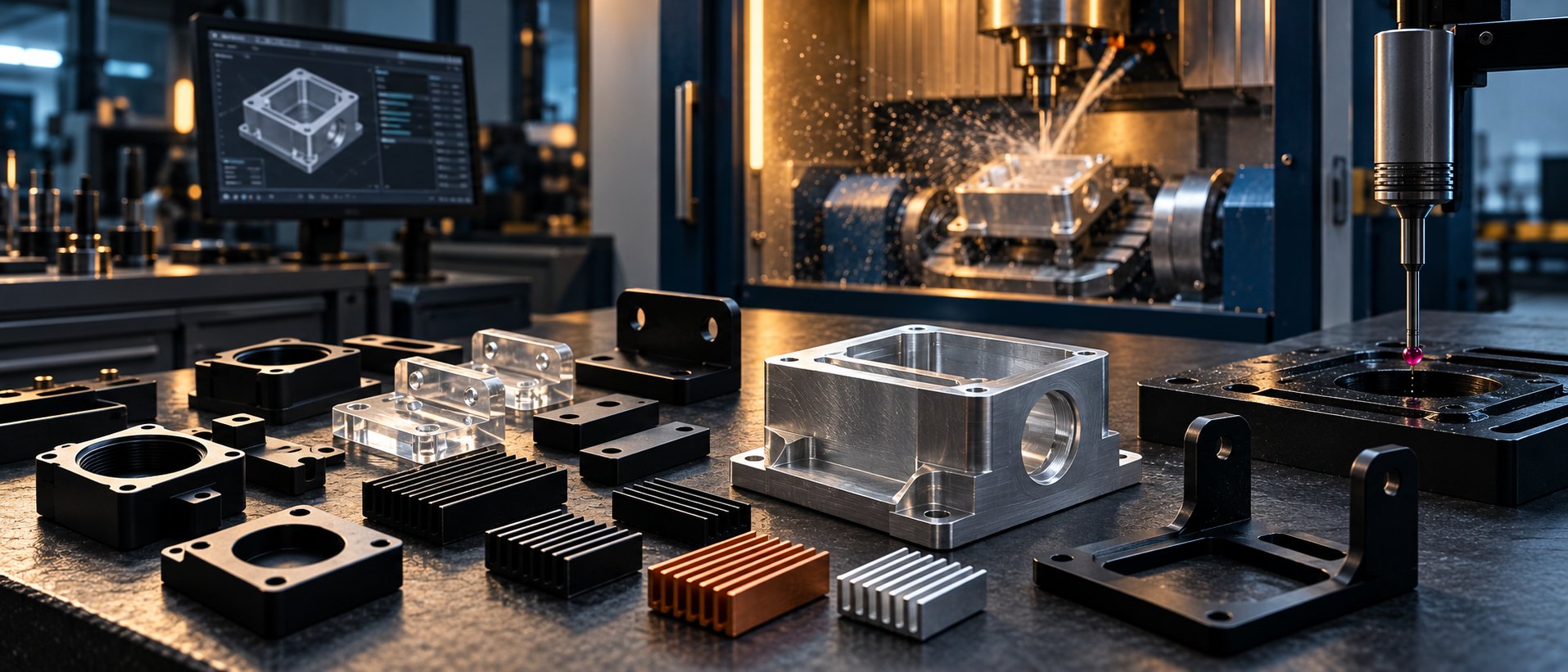
PEEK machining cost depends on more than the finished part. Your grade, blank size, material removal, quantity, thermal movement, and inspection requirements can change the quote before cutting starts. A quote-ready STEP comparison lets you see whether unfilled PEEK, GF30, or CF30 gives the lowest conforming-part cost.
The goal is to prevent a quote surprise caused by a real failure mode: warping after one-sided roughing or thermal growth exceeding the functional fit. The numbers below connect the same CAD part to stock selection, process planning, and purchasing decisions. Written by Ashkan, CNC engineer at CNC Instant Quote.
What drives PEEK machining cost after the quote?
PEEK machining cost is the sum of stock, removal, setup, cutting time, tooling, fixturing, heat treatment, finishing, inspection, and quantity. The PEEK Machining Cost Guide: Price Factors and Ways to Reduce Cost from Shenzhen Tuofa Technology Co., Ltd. separates these items because a small finished part can still require a large, expensive blank.
- Raw stock and the material discarded as chips.
- Setup count, probing, fixturing, and re-referencing.
- Machining time for pockets, thin walls, deep holes, and small radii.
- Tool wear, especially with glass- or carbon-reinforced grades.
- Annealing, stress relief, deburring, finishing, and inspection.
- Quantity, because setup cost is spread across more conforming parts.
The largest avoidable cost is often the buy-to-fly ratio. A 160 × 90 × 25 mm blank may be sensible for a 150 × 80 × 20 mm finished part, but a thicker or wider standard blank increases both material cost and cutting time. For related stock and tolerance decisions, see CNC Machining Design Mistakes Cost You More Than You Think.
How should you compare a PEEK CNC quote?
Compare grades with the same STEP part, blank dimensions, quantity, tolerance notes, and certificate requirement. Changing the material while changing the geometry hides the real purchasing decision. CNC Instant Quote's quote-stage test should use one 150 × 80 × 20 mm component from a 160 × 90 × 25 mm blank.
The same-part comparison to run
| Specified grade | Blank | Quantity | Measured quote delta | Use when |
|---|---|---|---|---|
| Unfilled PEEK | 160 × 90 × 25 mm | 1 and 10 | Record the live Q10 minus Q1 result | General-purpose parts when reinforcement is not required |
| GF30 PEEK | 160 × 90 × 25 mm | 1 and 10 | Record the live Q10 minus Q1 result | Stiffness or lower thermal growth is required |
| CF30 PEEK | 160 × 90 × 25 mm where supported | 1 and 10 | Record the live Q10 minus Q1 result | Higher strength-to-weight is required and the grade is supported |
The quote delta must come from the live CNC Instant Quote output. Do not replace it with a catalog PEEK machining price or an assumed kilogram rate. Record the displayed Q1 and Q10 values, then state the measured dollar difference beside the grade and certificate used. If CF30 is not supported for the part, mark it unavailable rather than substituting another carbon-filled grade.
Upload the STEP file with the specified grade, blank, quantity, tolerance, and certificate requirement. That prevents the clarification loop described in CNC Online Quote Threads: Avoid Clarifications.
Why does one-sided roughing warp an unfilled PEEK part?
Warping after one-sided roughing occurs when asymmetric material removal releases residual stress in unannealed stock. Makerstage reports 0.13–0.38 mm movement after rough machining a 100 mm diameter unannealed rod, which already exceeds the stated standard tolerance of ±0.13 mm.
- Identify one-sided stock removal in the STEP geometry. Failure mode: the remaining section moves after the stress balance changes.
- Specify the exact unfilled PEEK grade and certificate. Failure mode: an assumed grade can change stiffness, movement, and quote basis.
- Ask whether annealing or an intermediate stress-relief step is required. Failure mode: skipping it can leave the finished part outside tolerance.
- Allow for a roughing and finishing sequence. Failure mode: finishing a distorted part creates scrap instead of correcting the distortion.
- Inspect the first article before ordering 10 parts. Failure mode: repeating an unstable process multiplies the material loss.
The CNC Machining PEEK: Grades, Speeds & DFM Guide (2026) from Makerstage attributes the movement to residual stress in extruded stock. Annealing can add cost and lead time, but scrapping a $150–300 unfilled PEEK rod can cost more than the added process step.
When does thermal growth exceed the functional fit?
Thermal growth exceeds the fit when the operating temperature change moves a critical dimension farther than its tolerance allows. For unfilled PEEK, Makerstage gives a CTE of 47 µm/m/°C. A 150 mm shaft heated from 20 °C to 93 °C grows 0.52 mm, compared with a stated standard tolerance of ±0.13 mm.
| Specified grade | Thermal or machining point | Decision |
|---|---|---|
| Unfilled PEEK | CTE reported as 47 µm/m/°C; 150 mm grows 0.52 mm over 20–93 °C | Use only when the fit allows the movement or the design compensates for it |
| GF30 PEEK | Makerstage reports CTE of 27 µm/m/°C, about 42% lower than unfilled PEEK | Consider for dimensional stability when the certificate confirms GF30 |
| CF30 PEEK | Fiber reinforcement can improve strength-to-weight, but tool wear and availability must be checked | Use only when the specified CF30 grade is supported and function requires it |
Tie every thermal claim to the grade and certificate on your drawing. A generic “PEEK” note does not tell the shop whether the part is unfilled, GF30, or CF30. For drawing tolerances and legacy callouts, use CNC Quote ISO 2768: Legacy Drawing Rules before requesting a final quote.
FAQ: PEEK machining price and grade selection
What is a realistic PEEK machining price?
There is no useful fixed price without the STEP geometry, specified grade, blank, quantity, tolerances, and inspection requirements. The PEEK machining price includes material, removed stock, setups, cutting time, tooling, and any stress-relief work.
Is GF30 PEEK machining always cheaper?
No. GF30 PEEK machining can reduce thermal growth, but glass fiber increases tool wear and may raise machining cost. Compare it with unfilled PEEK using the same blank, quantity, certificate, and live quote.
What should you include in a PEEK CNC quote request?
Include the STEP file, specified grade, certificate requirement, blank or stock preference, quantity 1 and 10, critical tolerances, operating temperature, and fit dimensions. State which surfaces control sealing, alignment, or motion.
Prevent the expensive PEEK quote surprise
A reliable PEEK machining cost decision starts with one CAD part and a controlled comparison. Fix the blank at 160 × 90 × 25 mm, compare unfilled PEEK, GF30, and supported CF30, quote quantities 1 and 10, and check warping and thermal growth against the functional fit. Then request a CNC online quote for your STEP file →
Related guides
Price your part in seconds
Upload a STEP or IGES file — real geometry, real pricing, no waiting.