CNC Quote Quantity Breaks, Shown Line by Line
Published 2026-09-21 · updated 2026-09-23 · Machining Guides
Comparing unit prices without normalizing quantity, lot charges, and included scope creates bad purchasing decisions. CNC quote quantity breaks show where fixed setup, programming, and inspection costs spread across a run. Compare full lot totals at the same quantity, then divide by units: Shao-Yi’s example falls from $286.60 for one part to $19.06 each at 50.
I’m Ashkan, CNC engineer at CNC Instant Quote. The useful comparison is not a generic amortization formula. It is a CAD quote shown at practical breaks, with every lot and per-part line visible. Our CNC milling and turning capabilities cover aluminum, copper, brass, steel, and plastics from uploaded CAD geometry.
What do CNC quote quantity breaks actually measure?
CNC quote quantity breaks measure how fixed lot work is divided across the requested quantity. Programming, fixture preparation, machine setup, and some inspection work happen once per run, while machining and material charges usually repeat for each part.
DFW Machine’s May 2026 guide gives useful reference points: a 90-minute setup, a 7-minute cycle at $95 per hour, and typical NRE of $300–$1,500 for a moderately complex part. The 7-minute cycle alone equals $11.08 per part. DFW also notes that 6061 plate priced at $3.40 per pound raw can reach $4.50–$5.50 per pound through a shop.
Those figures are comparison inputs, not universal rates. A quote can show NRE separately, include it in setup, or reuse it on a repeat order. The scope beside each number matters as much as the number itself.
How does the unit price change from 1 to 500 parts?
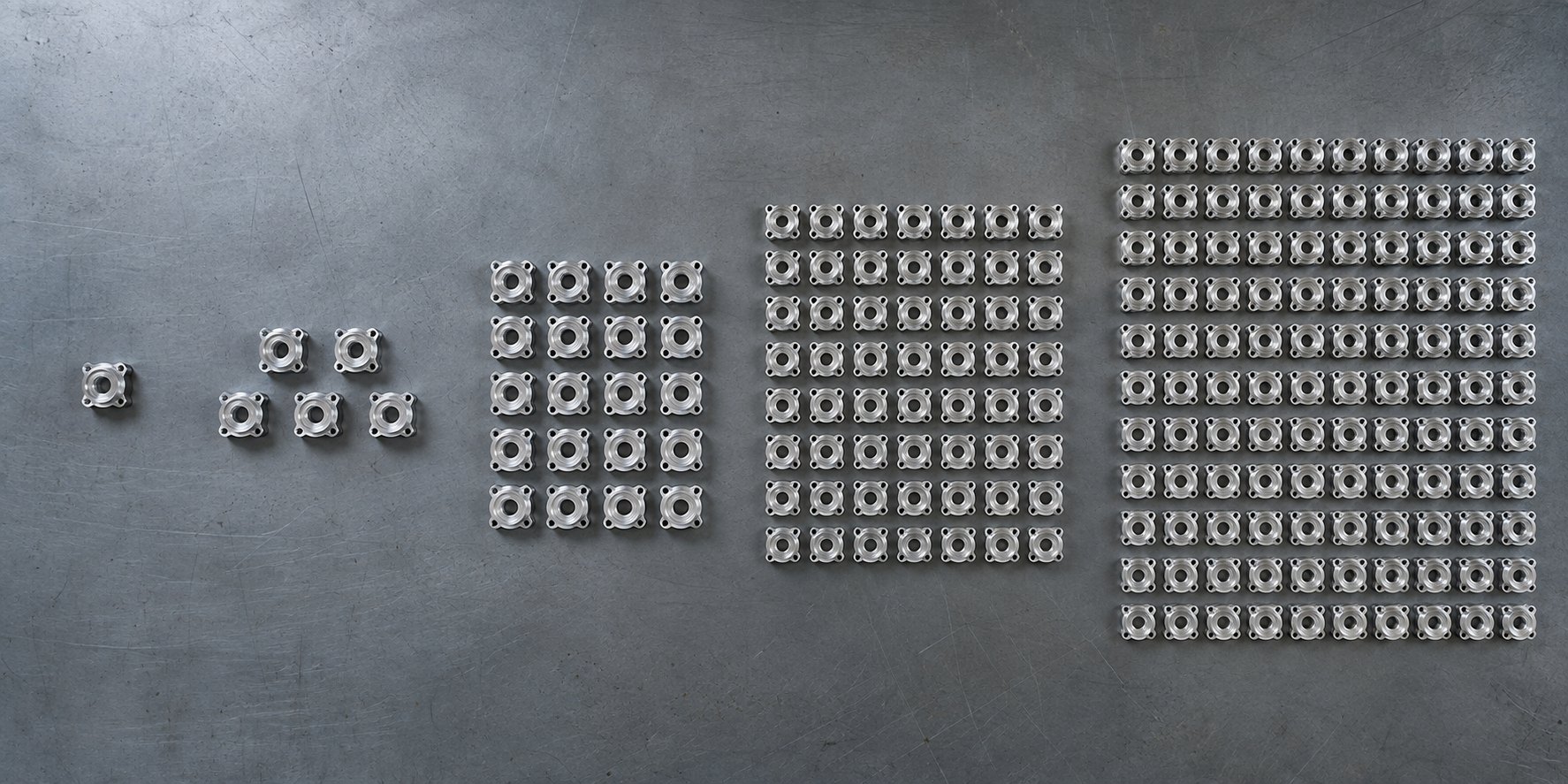
The largest unit-price drop usually occurs between 1 and 50 parts because the fixed charge has more units over which to spread. After that point, the variable machining charge controls more of the price.
| Quantity | Cost formula | Lot total | Unit price | What changes |
|---|---|---|---|---|
| 1 | $273 fixed + $13.60 variable | $286.60 | $286.60 | All fixed work lands on one part |
| 10 | $273 fixed + $136 variable | $409.00 | $40.90 | Fixed work is divided across ten parts |
| 50 | $273 fixed + $680 variable | $953.00 | $19.06 | The main quantity break is reached |
| 100 | $273 fixed + $1,360 variable | $1,633.00 | $16.33 | Fixed cost has a smaller effect |
| 500 | $273 fixed + $6,800 variable | $7,073.00 | $14.15 | Variable cost dominates the unit price |
Shao-Yi’s worked example uses a $273 fixed cost and a $13.60 variable cost. The unit price falls about 93% from one part to 50 parts, but only about 26% from 50 to 500. Ginwate’s guide makes the same practical point: by quantity 100, setup should largely disappear from the unit price.
Why is the first quantity break so expensive?
A prototype CNC quote carries the full programming, fixture, setup, and first-run inspection burden. At 50 parts, the same $273 fixed amount contributes $5.46 per part. At 100 parts, it contributes $2.73. The machining work itself has not become free; the denominator has changed.
What does a real STEP-file quote show at each break?
An anonymized CNC Instant Quote record for a 6061-T6 mounting clevis shows the line-by-line change. The STEP model measures 80 × 42 × 18 mm, includes two tapped holes, uses ±0.13 mm (±0.005 in) on non-critical dimensions, and calls for Ra 3.2 µm on machined faces.
| Quantity | Setup | Material | Inspection | Total price | Unit price | Lead time |
|---|---|---|---|---|---|---|
| 1 | 75 min | $8.20/part | $42 lot | $308.70 | $308.70 | 7 days |
| 5 | 75 min | $8.20/part | $42 lot | $415.50 | $83.10 | 8 days |
| 10 | 75 min | $8.20/part | $42 lot | $549.00 | $54.90 | 9 days |
| 50 | 75 min | $8.20/part | $68 lot | $1,643.00 | $32.86 | 12 days |
| 100 | 75 min | $8.20/part | $95 lot | $3,005.00 | $30.05 | 15 days |
The new-order quote uses $240 for programming and fixture setup, $8.20 material per part, $18.50 machining per part, and the inspection lot charge shown in the table. At quantity 50, the setup portion is $4.80 per part. At quantity 100, it is $2.40 per part.
Which charges are per lot and which are per part?
Lot charges apply once to the run. Per-part charges repeat with every unit. Separating them prevents you from treating a $42 inspection charge like a $42 charge on every part.
| Charge | Billing basis | Effect at higher quantity | Repeat-order treatment |
|---|---|---|---|
| Programming and fixture preparation | Per lot | Falls sharply per part | Program and fixture reused unless the model changes |
| Machine setup | Per lot | 75 minutes becomes a smaller fraction per part | Example repeat setup falls to 30 minutes |
| Material | Per part | Usually changes little per unit | Quoted again for the ordered quantity |
| Machining time | Per part | Remains the main variable charge | Requoted if geometry or process changes |
| Inspection | Per lot in this example | May rise when sample size or documentation expands | Can use an established inspection plan |
For this CNC Instant Quote example, repeat orders reuse the programming and fixture. The $240 first-order lot charge is not repeated in full. The next run uses a 30-minute setup, subject to the part remaining unchanged and the inspection scope staying the same. DFW Machine similarly explains that repeat orders can honor previous NRE.
See also: instant cnc online quote
How should you compare two CNC quotes at the same quantity?
Compare the total lot price first, then the unit price. Use the same quantity, material specification, inspection scope, and delivery requirement before deciding which quote is lower.
- Set one quantity for every supplier, such as 50 parts. Failure mode: comparing a 10-part prototype price with a 100-part production price.
- Mark each line as lot or per part. Failure mode: dividing a lot charge twice or missing a charge hidden inside the unit price.
- Confirm what the quote includes, especially programming, fixtures, inspection, and lead time. Failure mode: accepting a low price that omits first-run inspection.
- Calculate total divided by quantity. Failure mode: choosing the lowest headline unit price without checking the full run total.
- If your drawing uses legacy ISO 2768 notes, review ISO 2768 rules for legacy drawings before requesting a revised quote. Failure mode: changing tolerance interpretation after pricing.
FAQ: CNC quote quantity breaks
What is CNC setup cost per part?
CNC setup cost per part is the setup lot charge divided by the ordered quantity. A $240 setup charge equals $24 per part at 10 units, $4.80 at 50, and $2.40 at 100.
Does CNC machining quantity pricing include programming?
It depends on the quote format. Programming may appear as NRE, setup, or a combined lot charge. Ask whether the same program and fixture are reused on the next order.
Is a prototype CNC quote useful for production planning?
Yes, if you request the planned production quantity at the same time. A one-part price shows the first-run burden. It does not predict the unit price at 50 or 100 parts by itself.
Where can you get a quantity-normalized CNC quote?
Quantity breaks become useful when the quote exposes the math. Upload your STEP file for a quantity-normalized instant CNC quote with lot charges, per-part costs, setup minutes, and lead time shown at practical quantities →
Related guides
Price your part in seconds
Upload a STEP or IGES file — real geometry, real pricing, no waiting.