Copper CNC Machining: C101 vs C110 and Design Tips
Published 2026-07-07 · updated 2026-09-22 · Materials
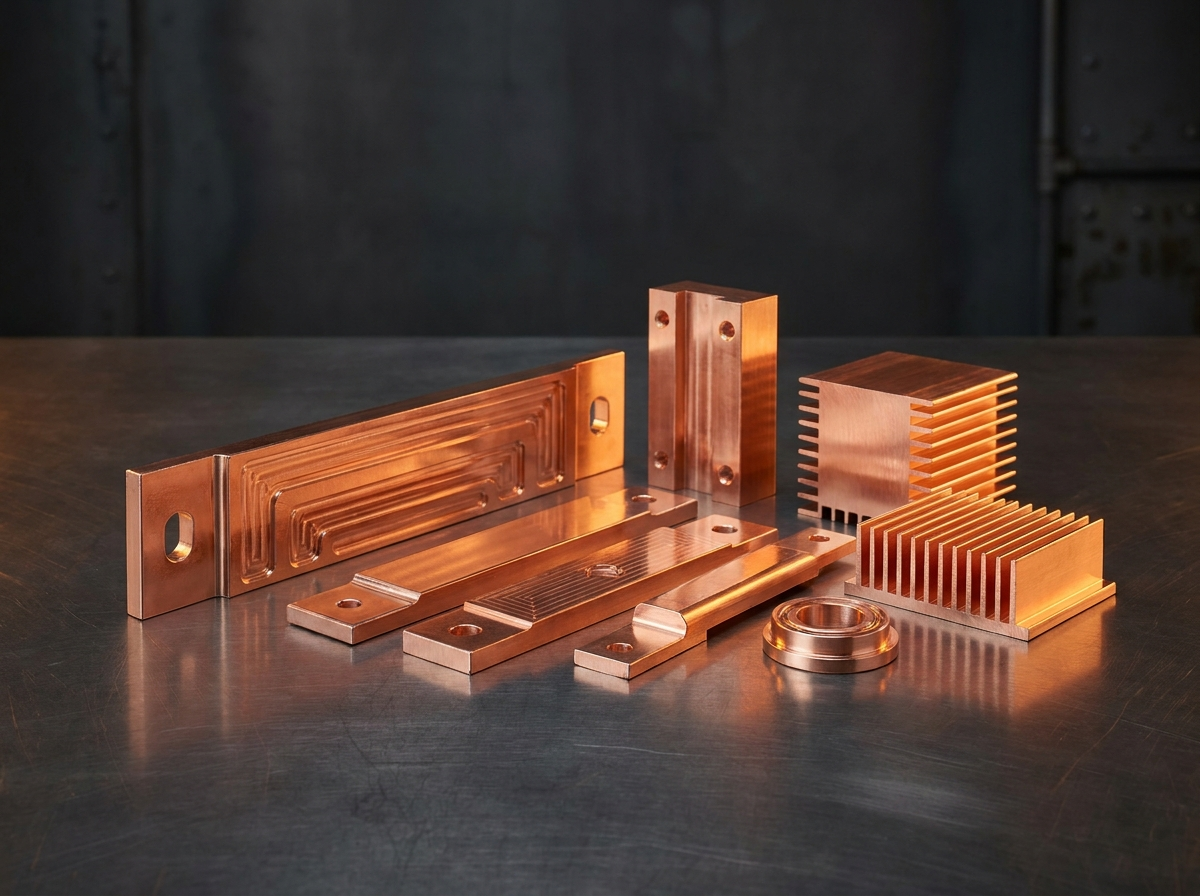
Copper is unforgiving to machine — it is gummy, work-hardens, and welds itself to dull tooling. But for bus bars, heat sinks, RF components, and electrodes, nothing else delivers the same electrical and thermal performance. Here is what matters when you order machined copper parts.
C101 vs C110: which grade?
C110 (Electrolytic Tough Pitch) is the standard: 100% IACS conductivity, widely stocked, and the most economical. It is the right choice for bus bars, terminals, and thermal parts.
C101 (Oxygen-Free, OFHC) offers marginally higher conductivity (101% IACS) and — critically — no oxygen embrittlement when hydrogen brazing or operating in vacuum. Specify C101 for vacuum chambers, cryogenics, particle accelerators, and hydrogen atmospheres; otherwise C110 saves money.
See also: cnc services
Design tips that cut cost
Copper machines at roughly half the removal rate of aluminum, so material removal drives price harder. Keep pockets shallow where possible, avoid thin walls under 1 mm (copper deflects), specify ±0.1 mm unless a feature genuinely needs tighter, and let us know if flatness matters — copper moves after heavy roughing.
Finishes
As-machined copper is bright but tarnishes within days. For appearance parts, choose polished; for corrosion protection with stable contact resistance, choose passivated. Both are quoted automatically with your part.
Ready to price a copper part? Upload your STEP file and switch between C101 and C110 to see the live difference, or read about our copper machining capability.
See also: cnc machining design mistakes cost
Related guides
Price your part in seconds
Upload a STEP or IGES file — real geometry, real pricing, no waiting.