Aluminum 6061 vs 7075 for CNC Machining: How to Choose
Published 2026-07-07 · updated 2026-09-22 · Materials
Choosing between aluminum 6061-T6 and 7075-T6 is one of the most common decisions in CNC machining — and picking the right one can cut your part cost by a third without giving up anything you actually need.
6061-T6: the workhorse
6061 is the default choice for machined parts, and for good reason. It machines beautifully, welds well, anodizes with consistent color, and resists corrosion. With a yield strength around 275 MPa, it is plenty strong for enclosures, brackets, fixtures, heat sinks, and most structural parts. It is also meaningfully cheaper than 7075 — both as raw stock and in machining time.
See also: copper parts cutting
7075-T6: aerospace strength
7075 is one of the strongest aluminum alloys available, with a yield strength around 503 MPa — nearly double 6061 and comparable to some mild steels at a third of the weight. That strength comes at a price: higher material cost, slightly slower machining, poor weldability, and less corrosion resistance (clear anodize or alodine is recommended).
See also: Shop Rate 6061-T6 Aerospace: What Sets the Price
How to decide
Choose 6061 when…
Cost matters, the part is not strength-limited, you need welding, or you want the best anodizing finish. This covers the vast majority of machined parts.
Choose 7075 when…
The part is highly loaded (aircraft fittings, gears, high-stress brackets), weight is critical, or fatigue life drives the design. If your FEA says 6061 is marginal, 7075 usually solves it without redesign.
Price the difference in seconds
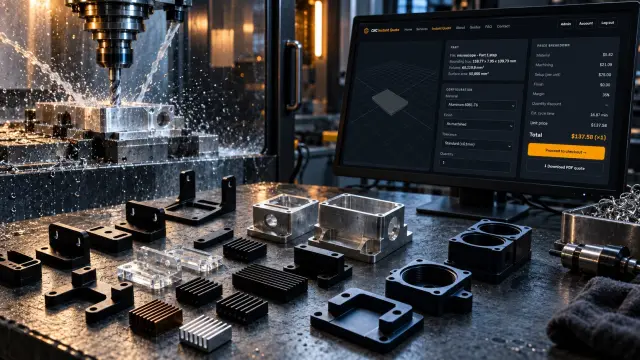
The fastest way to decide is to price both: upload your STEP file to our instant quote tool, quote it in 6061, then switch the material dropdown to 7075 — the price updates live. See our capabilities page for tolerances and finishes.
Related guides
Price your part in seconds
Upload a STEP or IGES file — real geometry, real pricing, no waiting.