Brass vs Aluminum Machining: Choose Before You Quote
Published 2026-11-21 · Materials
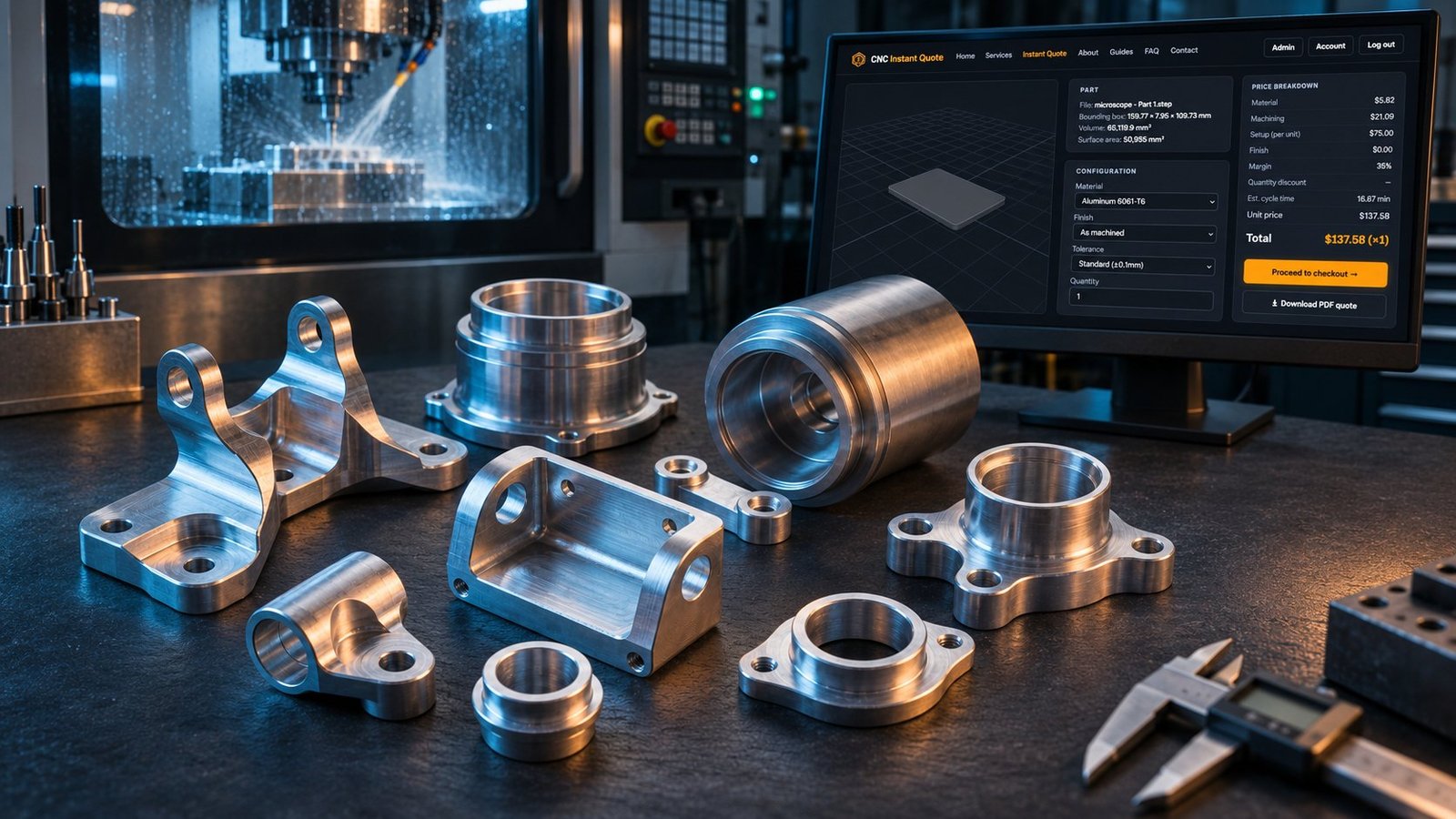
Brass vs aluminum machining is a quote decision, not a price-per-pound decision. Choose 6061-T6 when your part needs low mass, anodizing, or high strength-to-weight ratio. Choose UNS C36000 when short chips, direct threads, wear resistance, or turning cycle time can offset heavier, costlier stock. Then compare the uploaded geometry.
The same alloy name is not enough without stock form and quote date. The Material Report #021 dated November 17, 2026 shows why. Ashkan, CNC engineer at CNC Instant Quote, uses the quote-stage comparison below to separate material movement from the cost of actually making your part.
Which material wins in brass vs aluminum machining?
Choose 6061-T6 for lightweight housings, brackets, and large milled structures. Choose C36000 brass for fittings, connectors, direct threads, and wear features. The correct decision depends on function first, then the quote for your exact stock form and geometry.
| Part requirement | 6061-T6 aluminum | UNS C36000 brass | Use when |
|---|---|---|---|
| Low mass | Strong strength-to-weight ratio and lower finished mass | Heavier finished part and higher handling weight | Weight, shipping, or thermal enclosure size controls |
| Anodized appearance | Compatible with anodizing and lightweight housings | Not a substitute for an anodized aluminum finish | The finish is part of the product requirement |
| Threads and wear | May need careful tooling or thread reinforcement | Good choice for fittings, connectors, repeated threads, and wear surfaces | Assembly cycles and contact wear control service life |
| Large milled geometry | Often reduces stock mass and handling cost | Can increase material and shipping cost | The part has broad walls, pockets, or a large envelope |
Prolean describes the functional split clearly: aluminum suits lightweight housings and brackets, while brass suits fittings, connectors, threads, and wear features. For a broad plate with shallow profiles, compare routing milling before assuming the material alone controls the price.
Why does stock form change C360 vs 6061 cost?
Stock form can reverse the apparent winner. A lower 6061 bar price does not make 6061 plate cheaper, and a lower C360 price does not remove brass machining time or finished-part weight.
The Material Report #021 records three different movements on November 17, 2026: 6061 bar fell $0.13 per lb, 6061 plate rose $0.92 per lb, and C360 fell $0.055 per lb. That is the C360 vs 6061 cost question your quote must answer with the actual form of stock used.
- Name the alloy and temper: 6061-T6 or UNS C36000.
- Name the stock form: bar, plate, or another form selected for the geometry.
- Record the quote date because the same form can move differently from another form.
- Separate finished mass from starting-stock mass and chip recovery.
If a quote crosses a material or import-cost change, review CNC Machining Tariffs 2026: Why Your Quote Costs More before comparing an older price with a current one.
See also: CNC Instant Quoting: Test Quote Completeness
What does changing only material do to your uploaded quote?
A real brass machining quote can cost more for a milled bracket and less for a small turned fitting. We see the difference when the uploaded CAD file stays constant and only the material selection changes.
| Anonymized CAD part | 6061-T6 quote | C36000 quote | Price difference |
|---|---|---|---|
| Milled sensor bracket | Plate; finished mass 96 g; quantity 20; $18.42 per unit | Plate; finished mass 291 g; quantity 20; $24.77 per unit | C36000 is $6.35 higher per unit |
| Turned threaded fitting | Bar; finished mass 41 g; quantity 50; $8.60 per unit | Bar; finished mass 126 g; quantity 50; $7.95 per unit | C36000 is $0.65 lower per unit |
These two anonymized uploaded-part comparisons show why raw material price cannot stand in for unit price. Dazao reports a cycle-time comparison falling from 42 seconds in 6061-T6 to 26 seconds in C36000. Treat that as a reported comparison, not a universal guarantee. Your toolpath, tolerance, quantity, and setup count still control the result.
Before changing an alloy to solve a price problem, check CNC Machining Design Mistakes Cost You More Than You Think. If the geometry requires multiple orientations, use 3 Axis vs 5 Axis Quote: Choose by Setup Count to separate material cost from setup cost.
See also: CNC Quote ISO 2768: Legacy Drawing Rules
What failure mode changes the choice?
6061-T6 can produce built-up edge and stringy chips when lubrication, cutting conditions, or tooling are wrong. C36000 usually controls chips more cleanly, but brass is a poor substitute when low weight, anodizing, or strength-to-weight ratio controls the design.
When 6061-T6 fails on the machine
Prolean notes that aluminum can form long chips and built-up edges when speed, feed, and lubrication are not controlled. The trigger is a cutting edge that picks up aluminum. The result can be bird-nesting, manual chip clearing, poor surface finish, or a scored critical diameter.
When C36000 is the wrong substitute
Do not switch to brass to solve every machining problem. A heavier fitting may be acceptable, but a 6061-T6 enclosure that must remain light or receive anodizing should stay aluminum. The same applies to brackets where strength-to-weight ratio controls the design.
- If the part has long walls or a 2.0 mm target wall thickness, verify weight and deflection before choosing brass.
- If the part has repeated M6 threads or wear surfaces, compare direct-thread service life against any aluminum insert operation.
- If the finish requires anodizing, keep 6061-T6 in the comparison instead of treating brass as an equivalent finish option.
- If the quote uses a standard tolerance of ±0.1 mm or an as-machined target near Ra 3.2 µm, keep those requirements identical in both material scenarios.
How should you make the machining material choice before upload?
Make the machining material choice from four inputs: function, stock form, quote date, and the cost of the actual toolpath. Uploading the CAD file with those inputs defined gives you a usable comparison instead of a generic material price.
- Define the primary constraint. Failure mode: choosing brass for a weight-sensitive bracket or choosing aluminum for a wear-critical fitting.
- Select the stock form. Failure mode: applying a 6061 bar movement to a plate quote, or comparing bar and plate without recording the difference.
- Keep quantity, tolerance, finish, and thread requirements unchanged. Failure mode: attributing a setup or secondary-operation change to the alloy.
- Review the geometry and setup path. Failure mode: blaming material for a multi-orientation part when setup count is the larger cost driver.
FAQ: brass vs aluminum machining
Is C36000 always cheaper to machine than 6061-T6?
No. C36000 can reduce cycle time and chip-control work, but its heavier stock and higher material cost can make a milled bracket more expensive. The uploaded geometry decides.
Does the 6061 bar price apply to 6061 plate?
No. The Material Report recorded a $0.13 per lb drop for 6061 bar and a $0.92 per lb increase for 6061 plate on November 17, 2026. Stock form must appear in the quote.
Can C36000 replace 6061-T6 in a lightweight housing?
Usually not when low mass, anodizing, or strength-to-weight ratio controls the design. Brass is better reserved for fittings, connectors, threads, and wear features where its machining behavior adds value.
What should you do before you upload?
Use the same CAD geometry, quantity, tolerance, finish, stock form, and quote date when comparing C36000 with 6061-T6. CNC Instant Quote supports CNC milling and turning in aluminum, copper, brass, steel, and plastics from CAD geometry. For production-ready cnc machining milling services, compare the material and process together before you release the part →
Related guides
Price your part in seconds
Upload a STEP or IGES file — real geometry, real pricing, no waiting.