3 Axis vs 5 Axis Quote: Choose by Setup Count
Published 2026-11-16 · Machining Guides
A 3 axis vs 5 axis quote is decided by total setup work, not hourly rate alone. Choose 3-axis when one or two faces hold the features. Compare 3+2 or simultaneous 5-axis when angled holes, underside features, or a five-face tolerance relationship force re-clamping. Quantity determines whether the extra setup is worth paying for.
Your uploaded STEP file supplies the geometry, but the quote changes with feature count, material, tolerance, and batch size. The practical question is how many times the part must be located. Ashkan, CNC engineer, uses the same check for aluminum, copper, brass, steel, and plastic milling and turning.
What changes a 3 axis vs 5 axis quote?
Start with setups. A 3-axis route may have the lower machine rate, yet a four-setup job can lose after fixtures, loading, probing, and re-clamping are counted. A 5-axis route may cost more per hour but finish in one setup.
| Route | Typical access | Setup effect | Use when |
|---|---|---|---|
| 3-axis | Features visible from one tool direction | Each new face needs relocation | The part is prismatic and tolerance relationships stay on one or two faces |
| 3+2 positional | Fixed angled planes and compound-angle holes | Several orientations can share one clamping | You need angled access but not continuously changing tool orientation |
| Simultaneous 5-axis | Changing tool angles across a surface | One setup can cover complex access | The geometry includes sculpted surfaces, deep ports, blades, or impeller-like forms |
ISO 841 provides the axis naming convention: A rotates around X, B around Y, and C around Z. Those letters describe motion. They do not prove that one machine is inherently more accurate than another.
Wayzao explains that axis count mainly changes how many faces you can reach before unclamping. It does not automatically improve machine accuracy. Its worked comparison also shows why five separate setups create more datum transfers and tolerance-stack risk.
Quotometry makes the same cost distinction from the quote side. A four-setup 3-axis route can lose on fixtures, loading, and re-clamping even when its hourly rate is lower. Fewer relocations can also keep features on different faces aligned more consistently.
See also: CNC Quote ISO 2768: Legacy Drawing Rules
When does a 3+2 machining quote beat full 5-axis?
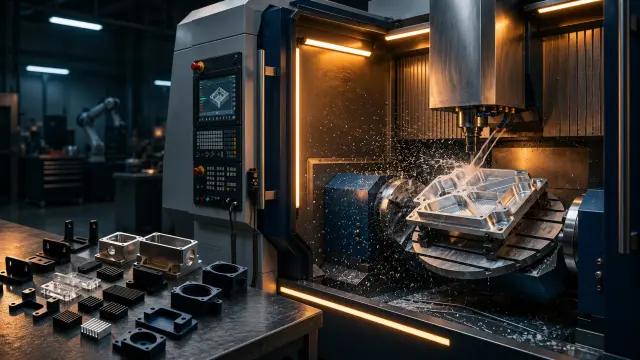
A 3+2 machining quote is usually the middle option for multi-face parts. The rotary axes position the tool or part at a fixed angle, then lock while X, Y, and Z perform the cut. Full simultaneous 5-axis keeps all five axes moving and costs more to program.
Use 3+2 for fixed angled access
Choose 3+2 for angled holes, tilted pockets, and several accessible faces that do not need a continuously changing tool angle. It often removes re-clamping without adding the programming burden of a sculpted simultaneous toolpath.
Reserve simultaneous 5-axis for changing surfaces
Full simultaneous 5-axis earns its cost when the cutter must follow changing surface normals. Impellers, turbine blades, ports, and freeform mold surfaces are typical triggers. Do not select it just because the part has five visible faces.
How do quantities 1, 20, and 100 change the quote?
At quantity 1, setup and programming dominate. At quantities 20 and 100, those fixed costs spread across more parts, so the lower per-part cycle cost matters more. A 5-axis route can win at low volume, while a well-fixtured 3-axis route can win in a longer run.
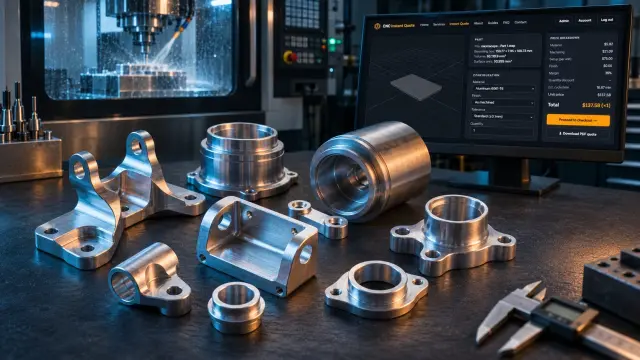
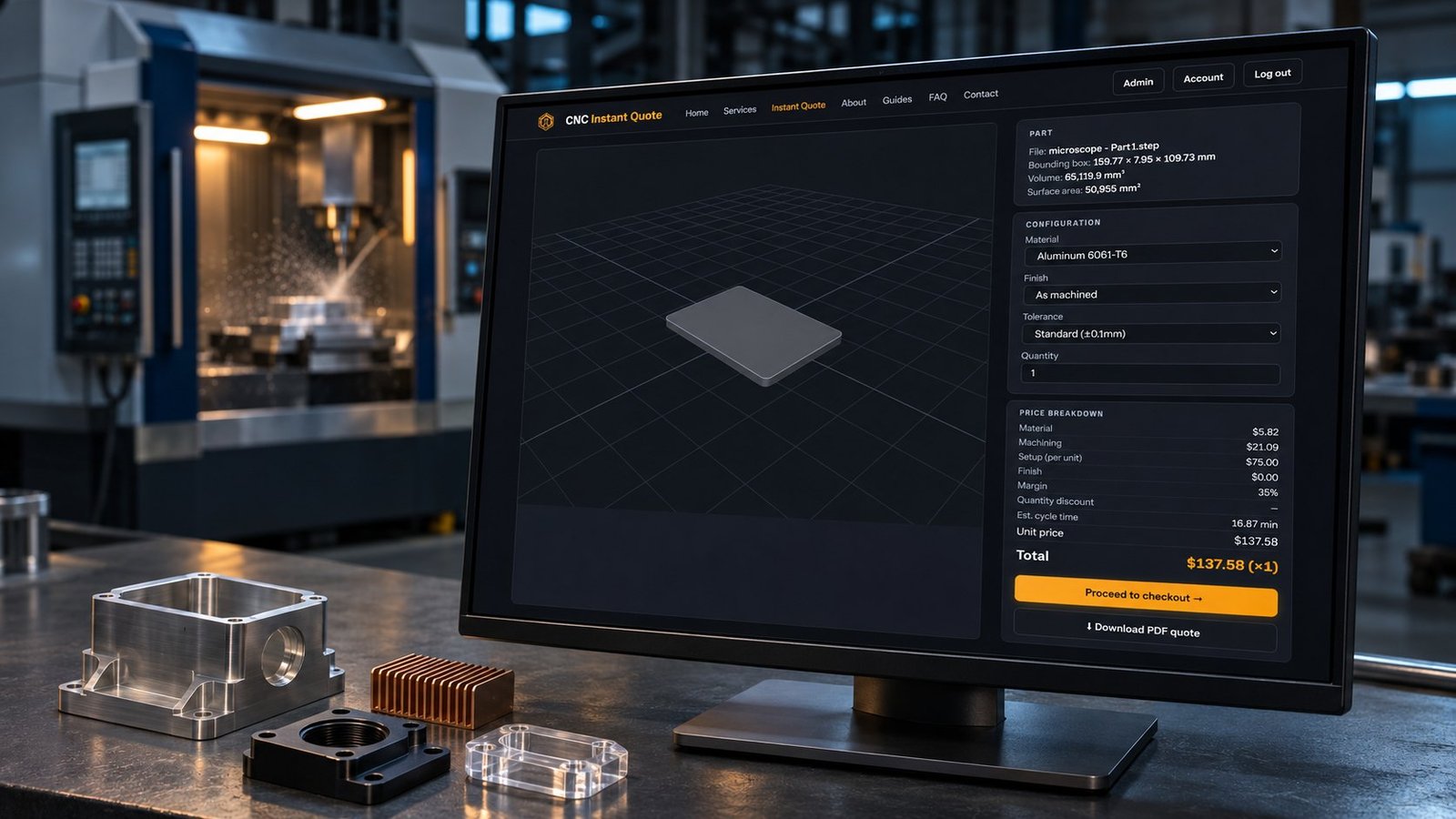
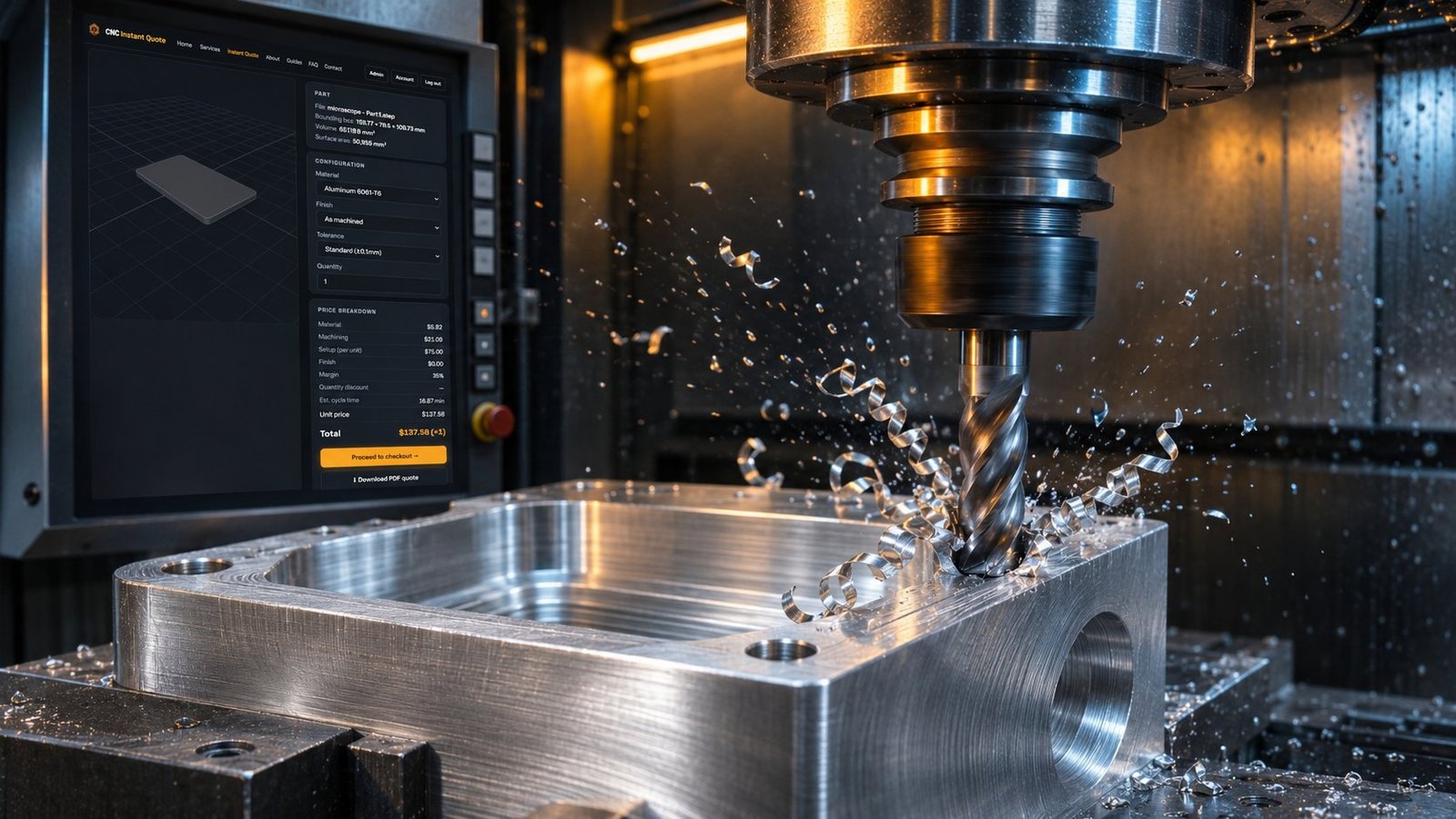
Consider an anonymized CNC Instant Quote record for one uploaded STEP file: a 159.77 × 7.95 × 109.73 mm part with 65,119.9 mm³ volume, Aluminum 6061-T6, and standard ±0.1 mm tolerance. The captured quantity-1 result is $137.58 per part. The record does not show quantities 20 or 100, route-level setup counts, or an actual price crossover, so those values are not invented here.
| Quantity | 3-axis planning case | 3+2 or 5-axis planning case | Quote check |
|---|---|---|---|
| 1 | Three setups expose the full fixture and handling cost | One setup may justify a higher 5 axis setup cost only if access is difficult | Check fixed setup, programming, and workholding charges |
| 20 | Three setups amortize across 20 parts | One setup amortizes across 20 parts | Compare unit price after loading and re-clamping time |
| 100 | Three setups may become efficient with repeatable fixtures | One setup still reduces handling but may carry a higher cycle rate | Confirm that 3-axis access does not create a tolerance failure |
MetronQ shows the same trade-off with a three-face aluminum 6061 bracket. Its 3-axis example uses three setups and displays €111.50 per piece. Its 5-axis example uses one setup and displays €120.39 per piece. The 5-axis example costs more per piece, proving that setup reduction does not guarantee the lowest multi-axis machining price.
Which features make the cheaper route fail?
The failure trigger is usually tool access combined with a tolerance relationship. Angled holes, underside features, or five faces tied to one datum can force re-clamping. Once that happens, compare the complete route instead of comparing machine-hour rates.
- Mark every machined face in the STEP file. Failure mode: an underside pocket or side bore is missed until the part needs a second fixture.
- Group features by tool direction. Failure mode: an angled hole requires a dedicated setup because a vertical tool cannot reach its axis.
- Identify dimensions that relate opposite or adjacent faces. Failure mode: datum transfer error creates a tolerance stack between features cut after re-clamping.
- Count loading, probing, and fixture changes for each quantity. Failure mode: the apparent 3-axis savings disappear under repeated handling.
- Check tool length and wall access. Failure mode: a deep cavity needs a long, flexible cutter, while a tilted approach could use a shorter tool.
If your geometry contains avoidable thin walls, deep pockets, or inaccessible corners, review CNC Machining Design Mistakes Cost You More Than You Think before choosing the machine route.
If the part is mostly a flat profile with open contours, compare the process choice in CNC Router vs Mill: Choose from Your CAD. If copper is replacing 6061-T6 for a heat sink, the cnc services online guide covers the material-specific quote concerns.
Material and supply effects can move the delivered price independently of axis count. When a previously stable quote changes, use CNC Machining Tariffs 2026: Why Your Quote Costs More to separate process cost from external cost.
See also: CNC Online Quote Threads: Avoid Clarifications
3 axis vs 5 axis quote FAQ
Does more axis count mean higher accuracy?
No. A 5-axis machine does not automatically make one feature more accurate. Its main accuracy benefit comes from keeping related features in one clamping instead of transferring datums between setups.
When is 3+2 enough?
3+2 is enough when the required tool angles are fixed. It suits angled holes, tilted planes, and most multi-face prismatic parts that do not need continuous tool-axis motion.
Can 5-axis be cheaper for one part?
Yes. One 5-axis setup can beat several 3-axis setups when fixtures, loading, probing, and re-clamping dominate the order. The result depends on geometry, quantity, programming, and the shop's rates.
What should you choose for your next quote?
Start with 3-axis pricing when your STEP file keeps critical features on one or two accessible faces. Compare 3+2 and simultaneous 5-axis when angled holes, underside features, or a five-face tolerance relationship would force re-clamping. For milling and turning in aluminum, copper, brass, steel, and plastics, review our CNC machining services →
Related guides
Price your part in seconds
Upload a STEP or IGES file — real geometry, real pricing, no waiting.